Tampilkan postingan dengan label Sauces. Tampilkan semua postingan

Chicago Deep Dish Pizza, or “Pizza” As We Call It In New York

The biggest problem with Chicago-style deep dish pizza, especially for a New Yorker, is that it’s called “pizza.” I’m not sure what else it could’ve, or should’ve been called, but when you grow eating thin-crust, and all of a sudden someone hands you a plate of this, with a fork, and calls it pizza, it’s quite the shock to the system.

Having said that, for the home cook at least, this deep dish pizza is actually much easier to pull off than your classic thin-crust, which really benefits from a 700 F. pizza oven. Another advantage is that we don’t have to worry about too much, or too many toppings, which is usually the fatal flaw of a poorly made NY-style pizza.

One key, besides the buttery, cornmeal-infused crust, is to be sure your sauce is very thick, and flavorful. Some Chicago pizzerias simply use seasoned, coarsely crushed tomatoes, but I prefer using a sauce, as long as it’s reduced at least as much as you see here. Your favorite will work, but just in case you don’t have one of those, here’s a link to our official pizza sauce recipe.

I went with a pretty basic sausage and cheese version here, but you can, and probably should, add other things like peppers, mushrooms, and onions. Same goes for switching up the cheeses, but I do like the combo of fresh, and firm mozzarella. I don’t think it’s quite as good if you use all one, or the other. Regardless, I really hope you give this “pizza” a try soon. Enjoy!


For the dough (enough for a 12-inch cast iron skillet):
1 1/3 cups warm water
2 1/4 teaspoons instant or rapid-rise yeast
2 teaspoons white sugar
1 1/2 teaspoons fine salt
1/4 cup melted butter
1/4 cup olive oil, plus more for the pan
1/2 cup cornmeal
3 3/4 cups flour, plus more as needed

For the fillings/toppings (in order of application):
4 ounces sliced provolone
8 ounces fresh mozzarella
1 pound spicy Italian sausage, removed from casing
4 ounces firm, low-moisture mozzarella
3 to 4 cups very thick pizza sauce (I made a double batch)
2 ounces (about 1 cup very finely grated) Parmigiano-Reggiano cheese
1 tablespoon olive oil for the top
more cheese and parsley to garnish

- Bake at 425 F. for about 35 minutes

Mumbo Sauce – Is D.C.’s Secret Sauce the Next Big Thing?

A friend of mine asked me recently if I’d ever heard of mumbo sauce, since she had just returned from Washington D.C., and said it was “everywhere.” I hadn’t, which isn’t a surprise, since unless you’re from the Capital, or select neighborhoods in Chicago, this stuff is virtually unknown.

Apparently, this sweet-and-sour condiment came to Washington D.C. via Chicago, where it somehow became a staple in Chinese take-out restaurants, served as a condiment with fried chicken wings, among other things. That’s as much background as you're getting here, and like many other regional culinary specialties, the history is murky.

All I know is that this was great with fried chicken wings, and I look forward to finding other uses for it, although I’m not sure French fries is going to be one of them. I’m a ketchup guy, and probably too old to change. Having said that, I can see this catching on, and for once, I’ll be ahead of a trend.

They say every takeout place in D.C. has their own secret recipe, but there were quite a few published recipes on the Internet, and so this is sort of a composite, based on the extensive, 20 minutes of research I did. Stay tuned for the chicken wing experiment I mentioned in the video, and in anticipation, I really do hope you give this a try soon. Enjoy!


Ingredients for about 4 cups of Mumbo Sauce:
1 can (6-oz) tomato paste
2/3 cup ketchup
1 cup distilled white vinegar
1 lemon, juiced
2/3 cup sugar
1/4 cup honey
2 tablespoons soy sauce
1 1/2 tablespoons freshly grated ginger
1 teaspoon cayenne pepper

- Please note: Every one of these ingredients is “to taste.”

Rigatoni al Segreto – Dinner and a Movie

This Rigatoni al Segreto recipe was the most closely guarded secret at Gino’s, one of New York City’s most famous Italian restaurants. It was as legendary, as their signature zebra-print wallpaper, and it won awards as the best red sauce in town. 

While there were rumors that the secret ingredient was butter, no one really knew for sure. Once the restaurant closed in 2010, the recipe got out, and indeed, the butter legend was confirmed. Having never been there, I was excited to try it, but there was a big problem. Actually, a small problem. The recipe called for just a half-tablespoon of butter. Regulars knew this couldn’t be right, and so the recipe remained a mystery. Was it a typo? Was the old chef just trolling people?

We may never have known; had it not been for a documentary called, “The Missing Ingredient.” It’s a great film, but despite the name, it’s not about the butter. However, there’s a scene near the end, where the old chef makes this pasta for the filmmaker, and it shows how much butter goes in.

He made a much larger amount than the published version, but I concluded that it was a typo, and should’ve been half a stick of butter. So, not only am I recommending that you make this delicious sauce, but I also really hope you checkout the movie soon (it’s on Netflix). Enjoy!


Ingredients for four small or two large portions:
4 tablespoons olive oil
1 cup diced onion
1 teaspoon salt, plus more to taste
2 or 3 cloves crushed garlic
a pinch of red pepper flakes (not in original recipe)
1 can (28 oz) San Marzano tomatoes, blended smooth
1/2 cup water to rinse out the can of tomatoes
Small handful of basil leaves, left whole or sliced just before adding
1 cup freshly grated Parmigiano-Reggiano (about 1.5 oz by weight), plus more to top
4 tablespoons butter, cubed
*8 ounces dry rigatoni

* This recipe probably makes enough sauce to coat 12 oz of pasta, but I like lots of sauce.

The Butcher's Steak – Too Good to Sell?

This great steak is considered something of a butcher shop “secret,” but not because they’re selfish, and can’t stand the thought of you being happy. It’s just an odd looking cut, which requires a specific trimming technique to remove one of the toughest pieces of connective tissue on the entire animal.

Combine that with the fact that there’s only one per cow, and you have something that’s a little tricky to sell, although that seems to be changing a bit. This steak has become popular on restaurant menus, going by the name, “hanger steak,” and that’s led to it being carried in some of your finer butcher shops.

Even though it takes a little bit of time, the trimming is pretty simple, and probably easier than I made it look. Carefully trim away any of the tough-feeling membranes on the surface, and divide in half lengthwise, along the center connective tissue. Once that’s cut away, you’re pretty much done, other than deciding how to cook it.

Butcher’s steak is great in a pan, under the broiler, and of course, on the grill. It takes to marinades wonderfully, and can sub in for any cut of steak in any recipe. It’s not only tender, and affordable, but also extremely beefy.

This is probably the most strongly flavored steak cut, and some even describe it as having a subtle gaminess, although I think that’s a bit much. There’s only one way to know for sure, so I really do hope you give this a try soon. Enjoy!


Ingredients for 4 portions:
1 whole butcher’s steak aka hanger steak, about 2 pounds
salt and freshly ground black pepper to taste
1 tablespoon clarified butter
For the sauce:
2/3 cup chicken broth to deglaze pan
juices from resting steaks
2 teaspoons balsamic vinegar, or to taste
2 tablespoon cold butter, cut in cubes
salt to taste

Bomba Calabrese – This Pepper Spread is the Bomb, Literally

This amazing Calabrian pepper spread is as delicious, as it is unknown. It doesn’t even have a Wikipedia page. Hey, even I have a Wikipedia page. But, despite the fact there’s not a lot of information available, I believe I got relatively close, and really love how this comes out.

As I said in the video, I like this best served simply on sliced bread, but beyond that, this is one of the most versatile condiments I know. You can toss it with pasta; add it to a sandwich; fill an omelet; top a pizza; use it like a salsa on grilled fish; spice up a potato salad; as well as create the world’s best deviled eggs. Actually, I’ve never made deviled eggs with it, but I know it’d be the best.

I was intentionally vague with the cooking times and temperatures. Basically, once the onion, eggplant, and mushroom mixture is sautéed, you add your peppers, and simply cook until everything is soft and tender, no matter how long it takes. You’ll probably stay between medium and medium high heat, but be prepared to adjust as need be. This is not something we want browning in the pan, before everything is cooked.

Another key is waiting for this to cool down completely, before you finalize the seasonings. We always want to adjust a recipe at the same temperature it’s going to be served at, since that just makes sense. Another thing that makes sense, and a lot of sense, is you giving this bomba Calabrese a try soon. Enjoy!


Ingredients to make about 4 cups Bomba Calabrese:
3/4 cup olive oil, divided
1/2 yellow onion
1 small eggplant
4-5 large button mushrooms
2 pounds hot cherry peppers (or about 1 pound after trimming)
1 pound sweet red bell peppers (or about 12 ounces after trimming)
1 teaspoon kosher salt, plus more to taste
1/2 teaspoon crushed fennel seeds
1 teaspoon dried oregano
1/4 cup white wine vinegar, or to taste

Proper Pesto

There are lots of recipes people claim taste better if made by hand, but there’s no easier case to prove than pesto. That the name means, “to crush,” should tell you something, and while this method does take considerably more physical effort, when you taste this you’ll forget every pestle-pounding minute.

The intensity of the flavors is beyond compare, and as if by some kind of magic, this gorgeous spread develops an addictive spiciness. You can taste each ingredient, and yet when smashed together, new and wonderful flavors are released. If you’re in the market, I recommend the marble mortar seen herein, as long as the inside has some texture to it. If it seems smooth and glassy, keep looking.

Of course, you can play around with the ratios of the five ingredients, and easily adjust this to your tastes, but no matter how they’re combined, taking the time to crush them by hand is well worth the effort. I hope you give this fresh basil pesto a try soon. Enjoy!


4 cloves garlic peeled
1/4 teaspoon kosher salt
1 large bunch basil (about 4-5 ounces)
3 tablespoons pine nuts
2 ounces Parmigiano-Reggiano, grated on microplace (about 1 1/2 cups unpacked)
1/2 cup mild extra virgin olive oil

Calamari Marinara – Would You Like That In 45 Seconds or 45 Minutes?

Calamari is affordable, delicious, and sustainable, yet many cooks shy away from it, since it has a reputation for being tricky to work with. I should’ve said “unfair reputation,” because while it’s true calamari can end up with a rubbery texture if overcooked, there’s a very simple way to avoid this… by really overcooking it.

When it comes to calamari, it needs to be cooked in either 45 seconds, or 45 minutes, and nothing in between. If you sear it in a pan, or poach it in a sauce for a very brief time, you should get something nice and tender. However, after just a few extra minutes, the squid gets chewy.

Unfortunately, this is how most calamari is served, since it is easy to overcook, even for a professional. But, if we gently simmer for about 45-minutes total, something amazing happens. The calamari loses that rubbery texture, and becomes tender once again.

I also think it takes on more a meaty flavor, which I love, especially when using this to sauce pasta. So, if you’ve wanted to try cooking calamari, but were afraid of over-cooking it, I really hope you give this easy sauce a try soon. Enjoy!


Ingredients for 4 portions:
2 tablespoons olive oil
1  yellow onion, sliced thin
4 garlic cloves, crushed
1 anchovy fillet
1/2 teaspoon red pepper flakes
1 Serrano chili pepper sliced thin
1/2 teaspoons salt, plus more if needed
1/2 cup drinkable white wine
1 cup clam juice
6 cups crushed or puréed Italian plum tomatoes
1/2 teaspoon dried oregano
2 pounds frozen calamari tubes and tentacles, thawed, sliced into half-inch pieces
1/4 cup freshly chopped Italian parsley
freshly grated Parmigiano-Reggiano, optional
1 pound dry pasta

Fresh Strawberry Jam – Because Man Cannot Live on Clotted Cream Alone

Actually, I don’t think you can live on just clotted cream and fruit preserves either, but regardless, as promised, here’s my preferred method for making strawberry jam. While amazingly delicious, and quite satisfying to make, I’ll have to put this on the same list as homemade ketchup. This is fun to make once in a while, but due to the effort, and time involved, Smuckers has nothing to worry about.

This version features a lot less sugar than many recipes, which is kind of crazy, since we use over two cups, as well as a homemade pectin puree, to help tighten-up the texture. Feel free to use pectin powder or liquid instead, but I think I did a pretty good job explaining why I don’t in the video.

Strawberries should be sweet, and plentiful this time year, so if you’re looking for a fun project, especially if your last fun project was making clotted cream, I really hope you give this delicious, fresh strawberry jam a try soon. Enjoy!


Ingredients for about 3 cups of Strawberry Jam:
For the pectin puree:
3 apples, chopped
1 lemon, chopped
1 cup water
For the jam:
3 pounds strawberries, rinsed, and trimmed
1 1/2 cups (or whatever you got) pectin puree
2 1/4 cups white sugar, added in two additions
1 teaspoon fresh lemon juice

Please Note: To test without a thermometer, wait until the jam starts to reduce and thicken, and spoon some of the mixture on a plate, and place in the freezer for a few minutes, until the jam is cold. If it's jelled, you're done. If it's still runny, keep cooking, and testing. 

The Name's Cream...Clotted Cream

If you invented a cream preparation so incredibly delicious that you couldn’t bear the thought of anyone besides you, and the other dairy farmers in the area enjoying it, adding the word “clotted” to the name is a pretty sound strategy.

While the name doesn’t exactly make the mouth water, the flavor and texture are the stuff of legends. The long, slow cooking sort of toasts the cream, which imparts a sweet, nuttiness that I don’t think I’ve tasted in any other preparation.

Most modern ovens go down as low as 175-180 F., which is ideal for this technique. 200 F. will work, but maybe check after 10 hours, and see how things look. The other huge factor here is the cream. Be sure to get the best you can. It should be from grass-fed cows, and have a fat content of between 36-40%.

Avoid anything that says “Ultra-Pasteurized,” since it’s been heat-treated, and you’ll not get the same results. Other than this taking a day or two, the technique could not be easier, and I wasn’t exaggerating when I said it’s one of the most amazing things ever. I really do hope you give this a try soon.  Enjoy!


Ingredients:
4 cups heavy cream
8 x 8-inch glass or ceramic baking dish
- Bake at 175-180 F. for 12 hours. Chill overnight before separating the “clots.” Use the reserved liquid for baking biscuits.

Norwegian Butter Sauce – Better Know as Sandefjordsmør

My Norwegian pronunciations aren’t any better than my French ones, but as challenging as saying, “Sandefjordsmør,” may be, this amazingly simple butter sauce is not very challenging to make. 

People get nervous about butter sauce, since many types can easily “break,” which means the butter separates, but because of the cream, this is extremely stable, and very user-friendly. As long you don’t dump all the cold butter cubes in at once, and just toss them in a few at a time, your sauce will not break. 

Along the same lines, if you make the sauce early, be sure to keep it in a warm spot, since if it gets cold and solidifies, and then you try and reheat it, the butter will most likely separate. Above and beyond being easy, and relatively sturdy, this Sandefjordsmør is also quite versatile.

Not only is it wonderful on all types of fish, but also works beautifully with shrimp and lobster. Speaking of versatility, the same goes for changing up the herbs. So, no matter how you flavor it, or what you spoon it over, I really hope you give this a try soon. Enjoy!


Ingredients for 4 servings:
2 lemons, juiced
1/2 cup heavy cream
5 tablespoons cold unsalted, grass-fed butter, cut in cubes
salt and cayenne to taste
2 generous tablespoons chopped Italian parsley

Béarnaise Sauce – Maybe My Favorite ‘Aise

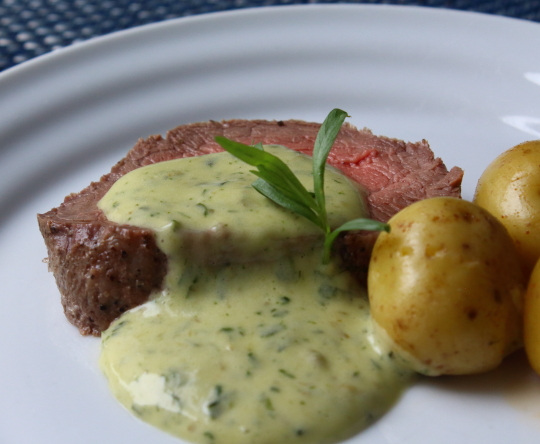
I adore a good hollandaise, and couldn’t survive without mayonnaise, but if I had to pick an all-time favorite ’aise, it might just be béarnaise. This tarragon-spiked, shallot-infused hollandaise is absolutely perfect with any and all steaks or roasts; especially lean ones, like our recent salt-crust beef tenderloin.

A sauce made from 75% butter has some advantages, and elevating lean meat is just one of them. This is also excellent on potatoes, vegetables, as well as just about any seafood I can imagine. And as I mentioned in the video, this can be used to make quite the memorable eggs Benedict.

We’re using the same revolutionary technique here that we featured in our last hollandaise sauce video, with one small tweak. If you’re feeling lucky, try to create your hollandaise over medium heat, instead of low. That’s what I usually use, but I played it safe, and went with low heat in that recipe, even though using medium is much faster.

You’ll have to keep an eye on things, but you should get results similar to what you see in this video. By the way, just like when making regular hollandaise you can adjust the thickness by adding in a little hot water if necessary. So, whether you’re going to enjoy this with salt-crusted beef tenderloin, or something else just as special, I hope you give this béarnaise sauce a try soon. Enjoy!


For the reduction:
1 cup fresh tarragon leaves, roughly chopped
1/2 cup thinly sliced shallots
1 rounded teaspoon whole black peppercorns
1/2 cup white wine vinegar
1/2 cup white wine
1/3 cup water

For the compound butter:
1/4 cup chopped tarragon
1 teaspoon drained capers
1 tablespoon cold butter

For the béarnaise:
2 large egg yolks
3 tablespoons tarragon vinegar reduction
8 tablespoons cold unsalted butter, cubed
1 tablespoon caper tarragon compound butter
salt and cayenne pepper to taste
freshly ground black pepper, optional

Chicken à la King – Only in America

Chicken à la King is one of my favorite classic, comfort foods, and in additional to being delicious, you also get to make up your own story of where the name came from. Just promise me not to use mine. You can have the recipe, but the Don King story is proprietary.

This is an easy recipe to adapt, and you can also make it thicker/thinner if you want by simply changing the amount of roux. Have a little extra stock on hand to thin if need be, and not a lot can go wrong. And don’t even get me started on how great this is for using up leftover vegetables.

As I mentioned in the video, I’ll normally make this kind of thing the day after roasting a big chicken. You can eat some, and save the rest of the meat and bones for this. Or, you can just roast two chickens. They refer to that as “have your chicken and eat it too.” I really hope you give this a try soon. Enjoy!


Ingredients for two large, or four small portions:
6 tablespoon unsalted butter
1/2 pound sliced mushrooms
2 large shallots, minced
1 cup diced sweet bell peppers
salt and freshly ground black pepper to taste
1/3 cup to 1/2 cup all-purpose flour, depending on how thick you want it
1/4 cup dry sherry (there is no substitute, except maybe a little splash of a mild, sweeter vinegar)
3 1/2 cups chicken stock or broth
pinch of freshly grated nutmeg
pinch of cayenne pepper
2 teaspoons fresh thyme
1 tablespoon Italian parsley
1/3 cup creme fraiche or heavy cream
4 cups cubed roasted chicken
fresh chives to garnish

Eastern North Carolina-Style Barbecue Sauce with a West Coast Twist

I’m not sure if using honey instead of sugar really qualifies as a “West Coast twist,” but it does ensure that people from North Carolina can’t attack me for this Eastern North Carolina-style barbecue sauce not being authentic. 

Anyway, while this isn’t exactly what you might find in the Tar Heel State, it was fantastic on the pork, and I hope it inspires you to add this deliciously different barbecue sauce in your repertoire.

As I mentioned in the video, I’m heading down to SoCal to work on a top-secret project, but since I teased this sauce in the recent paper pork recipe, I wanted to get this posted before I left. Unfortunately, I can’t give any details about what I’m doing down there, but let’s just say…actually, I can’t even say that. So stay tuned, and in the meantime, I really do hope you give this a try soon.  Enjoy!


Ingredients:
1 tablespoon honey, or other sweetener to taste
1 generous tablespoon freshly ground black pepper
1 generous tablespoon hot red pepper flakes
1/2 cup apple cider vinegar
1/2 cup white distilled vinegar
3/4 teaspoon Kosher salt

Grilled Shrimp Louie – Dressing Up a Classic

I don’t do a lot of salad dressing videos, since it’s pretty much just adding things to a bowl, but when that dressing is going on a grilled shrimp Louie, I’ll make an exception. By the way, this is usually done with crab, but I think the smoky, grilled shrimp are a great summertime twist.

This is my take on a classic Louie dressing, and as with all such recipes, you’ll need to taste and adjust for acid, salt, and heat. Just be sure to wait until the dressing is nice and cold before tasting. You’ll get a more accurate reading, since that’s the temperature we’re going to be serving at.

If you do grill the shrimp, don’t toss it with the oil and lemon until right before you grill. This isn’t a marinade, and we don’t want the shrimp to start “cooking” in the acid. I really hope you give this a try soon. Enjoy!


Ingredients for about 1 3/4 cups:
1 cup mayonnaise
1/3 cup ketchup
1/4 cup crème fraiche
1 tablespoon freshly squeezed lemon juice
1 teaspoon apple cider vinegar
1 packed teaspoon brown sugar
1 teaspoon paprika
1/8 teaspoon cayenne
1/4 teaspoon kosher salt, or to taste
1/2 teaspoon Worcestershire sauce
2 tablespoons minced green onion
2 tablespoons freshly chopped parsley

For the grilled shrimp:
2 pounds peeled and deveined shrimp
1 tablespoon olive oil
juice from 1/2 lemon
1/4 teaspoon smoked paprika
1 teaspoon kosher salt